
Imagine reaching into a refrigerator on a warm afternoon, pulling out a cold Coca-Cola can, and noticing something you probably never thought about before.
It looks simple, doesn’t it? A little aluminum cylinder, a familiar red design, and that satisfying sound when the pull tab opens.
Yet, behind this everyday beverage container sits a surprisingly interesting world of measurements, engineering, packaging decisions, and clever design.
A Coke can is more than just a place to keep a fizzy drink. Its height, width, diameter, and capacity all play a role in how comfortably it fits into your hand, how easily it slides into a refrigerator shelf, and how efficiently thousands of cans can be transported together.
Whether you’re measuring a can for a school project, designing a printable label, checking whether it fits inside your car’s cup holder, or simply wondering how big a regular soda can really is, understanding Coke Can Size can be genuinely useful.
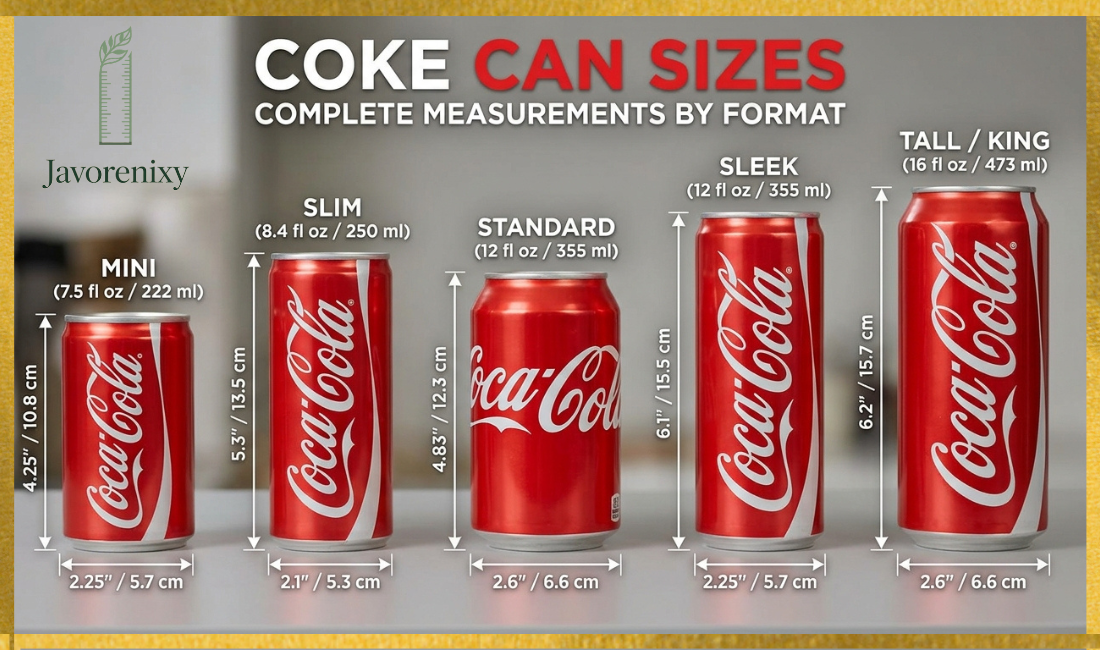
The familiar American 12-ounce Coca-Cola can is approximately 4.83 inches tall and 2.60 inches wide. But that’s only one member of a much larger family. Mini cans, slim cans, tall cans, and international formats all bring their own dimensions to the table.
Let’s explore the measurements, compare different formats, and uncover the little details that make Coca-Cola packaging so interesting.
| Coke Can Size | Height | Diameter | Capacity |
|---|---|---|---|
| Mini Can | 4.83 in (12.3 cm) | 2.13 in (5.4 cm) | 7.5 oz (222 mL) |
| Standard Can | 4.83 in (12.3 cm) | 2.60 in (6.6 cm) | 12 oz (355 mL) |
| Slim Can | 5.75 in (14.6 cm) | 2.25 in (5.7 cm) | 12 oz (355 mL) |
| Tall Can | 6.20 in (15.7 cm) | 2.60 in (6.6 cm) | 16 oz (473 mL) |
Understanding Standard Coke Can Size
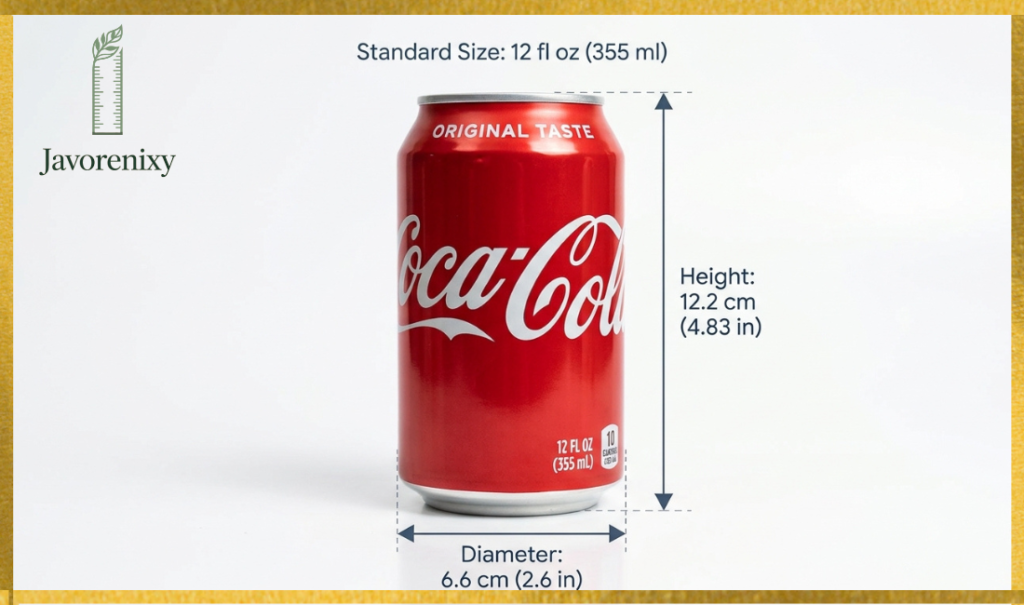
When someone mentions a regular Coke can, they’re usually talking about the traditional 12-ounce aluminum container commonly sold throughout the United States.
It’s the familiar size found in vending machines, grocery stores, restaurants, lunch boxes, and those six-pack carriers that somehow always seem to disappear from the refrigerator first.
A standard 12 oz Coke can holds approximately 355 milliliters of carbonated beverage.
Here are its commonly referenced dimensions:
| Measurement | Approximate size |
|---|---|
| Capacity | 12 oz / 355 ml |
| Height | 4.83 inches |
| Height in centimeters | 12.27 cm |
| Height in millimeters | 122.68 mm |
| Body diameter | 2.60 inches |
| Diameter in centimeters | 6.60 cm |
| Diameter in millimeters | 66.04 mm |
| Lid diameter | 2.13 inches |
| Lid diameter in millimeters | 54.10 mm |
| Circumference | 8.17 inches |
| Circumference in centimeters | 20.75 cm |
| Empty can weight | Approximately 0.53 oz |
| Full can weight | Approximately 13 oz |
These measurements are useful reference figures, although actual dimensions can vary slightly between manufacturers, production facilities, and packaging designs.
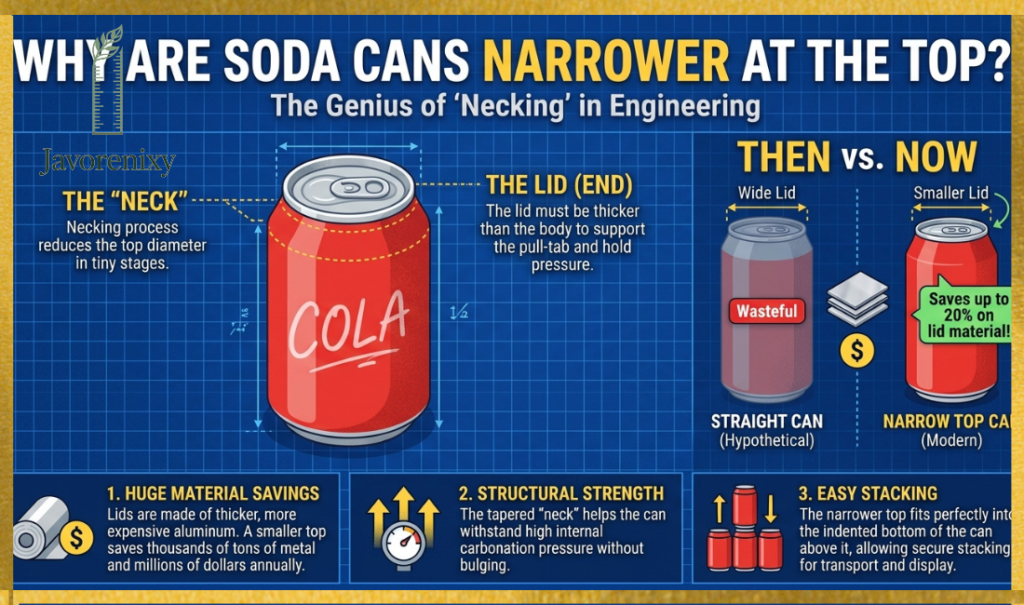
One interesting thing about a standard Coke can is that it isn’t perfectly cylindrical from top to bottom. The upper section narrows toward the lid, creating a slightly smaller opening than the main body.
That little design choice makes a surprising difference in material usage and overall strength.
Coke Can Dimensions in Inches, Centimeters, and Millimeters
Measurements become much easier to understand when you can switch between imperial and metric units.
Someone in the United States might describe a can as being about 4.83 inches tall, while someone in Europe or Asia may prefer 12.27 centimeters.
Both measurements describe the same familiar object.
Let’s break down the most important Coke can dimensions.
Height of a Coke Can
The standard American 12-ounce Coca-Cola can measures approximately:
- 4.83 inches tall.
- 12.27 centimeters tall.
- 122.68 millimeters tall.
Imagine placing a can upright beside a small paperback book. The can’s height gives you a useful everyday reference for understanding its proportions.
Remember that height is measured from the bottom of the can to the highest point of its top closure, not just the straight aluminum body.
Coke Can Diameter
The main body diameter is approximately:
- 2.60 inches.
- 6.60 centimeters.
- 66.04 millimeters.
Diameter means the distance across the circular body through its center.
This is particularly important when checking whether a can will fit into a narrow compartment or a particular cup holder.
Coke Can Circumference
Circumference describes the distance around the outside of the circular can.
For a standard Coke can, the approximate circumference is 8.17 inches, or 20.75 centimeters.
This measurement is especially useful for people designing packaging labels, promotional stickers, or custom decorative wraps.
Coke Can Radius
Radius is simply half the diameter.
For a standard 12-ounce can:
- Diameter: 2.60 inches.
- Radius: 1.30 inches.
- Radius in centimeters: Approximately 3.30 cm.
If you’re drawing the circular outline of a Coke can in a design application, this measurement can help you establish the correct proportions.
Coke Can Size Chart: Every Popular Format
Not every Coca-Cola can is created for the same occasion.
Some people prefer a smaller serving that doesn’t leave half a drink sitting on the kitchen counter. Others want a larger container for long journeys, busy afternoons, or sharing with friends.
That’s why beverage manufacturers offer multiple formats.
The following chart provides useful approximate capacities and representative dimensions. Sizes can differ by country and product packaging.
| Coke can format | Capacity | Approximate dimensions |
|---|---|---|
| Mini Coke can | 7.5 oz / 222 ml | 3.7–4.0 in tall |
| Small slim can | 250 ml | 5.2–5.5 in tall |
| Standard US can | 12 oz / 355 ml | 4.83 in tall |
| European-style can | 330 ml | 4.5–4.8 in tall |
| Tallboy can | 16 oz / 473 ml | 6.0–6.3 in tall |
| Large can | 20 oz / 591 ml | Varies by market |
| Australian format | 375 ml | Varies by manufacturer |
These are reference ranges rather than universal specifications. In particular, a 250 ml can may have a slim profile, while a similarly sized beverage container may use a different body shape.
Let’s look at each format more closely.
Mini Coke Can Size: The Smaller Refreshment
Mini Coke cans are popular with people who enjoy a smaller serving rather than opening a full-size drink every time.
A common American mini format holds 7.5 fluid ounces, equivalent to approximately 222 milliliters.
Typical reference dimensions include:
- Capacity: 7.5 oz.
- Height: Approximately 3.7–4.0 inches.
- Body diameter: Around 2.25–2.60 inches, depending on design.
- Volume: Approximately 222 ml.
The mini format is especially handy for packed lunches, small refrigerators, parties, and situations where you want a little refreshment without committing to a larger serving.
There’s also a practical advantage: smaller cans can make portion planning easier.
However, don’t assume that every mini Coke can has identical measurements. Some markets use different proportions and packaging styles.
250ml Slim Coke Can Dimensions
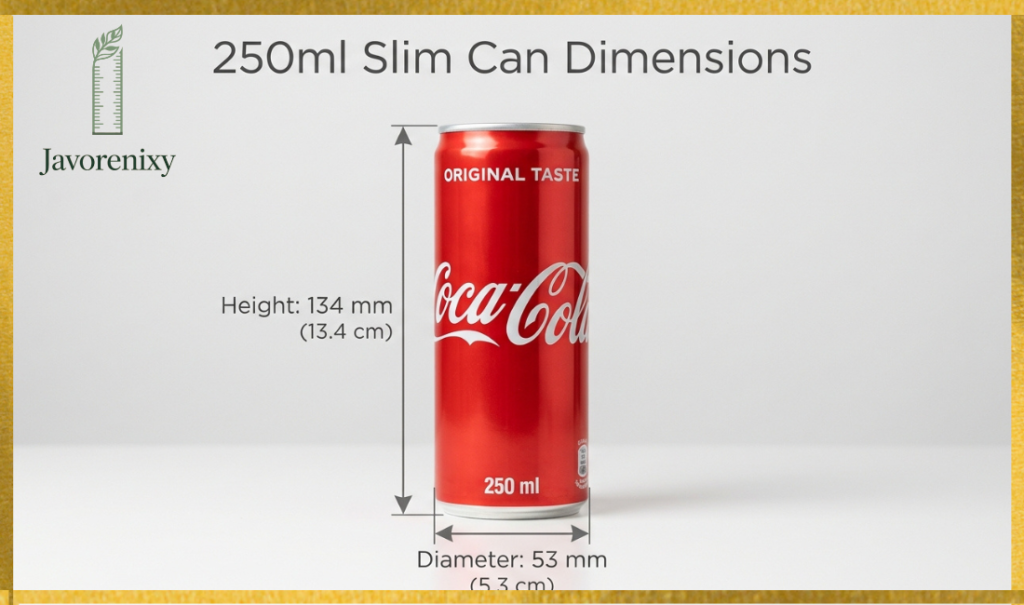
The 250 ml format is a popular smaller beverage option in several international markets.
Unlike the familiar American soda can, a slim or sleek version has a narrower appearance and a taller profile.
Its typical characteristics include:
- Capacity: 250 ml.
- Capacity in ounces: Approximately 8.45 US fluid ounces.
- Approximate height: 5.2–5.5 inches for some slim formats.
- Narrower body than many standard soda cans.
The slim profile gives the container a different visual personality. It looks more delicate, fits comfortably in many hands, and offers a modern appearance on retail shelves.
But here’s something worth remembering: slim Coke can dimensions aren’t fixed across every manufacturer or region. A 250 ml can may have different proportions depending on its intended market.
Standard 12 oz Coke Can Size
The traditional 12-ounce can remains one of the most recognizable beverage containers in the world.
Its approximate measurements are:
- Height: 4.83 inches.
- Diameter: 2.60 inches.
- Circumference: 8.17 inches.
- Capacity: 355 ml.
This is the format most people picture when someone says Coke can.
It has a practical balance between capacity and portability. It fits many refrigerator shelves, standard beverage carriers, and numerous cup holders.
The proportions are also efficient for transportation. Thousands of identical cans can be arranged in compact packaging configurations without wasting excessive space.
330ml European Coke Can Size
In many European markets, the 330 ml can is a familiar format.
It contains approximately 11.16 US fluid ounces, making it slightly smaller in capacity than the American 355 ml version.
Common characteristics include:
- Capacity: 330 ml.
- Capacity in ounces: 11.16 oz.
- Height: Often around 4.5–4.8 inches, depending on the can design.
- Body diameter: Varies by packaging specification.
One interesting detail is that the 330 ml format is also widely used for other beverages, including sparkling water, energy drinks, and soft drinks.
The packaging looks familiar, but the proportions may differ from those of an American 12-ounce can.
375ml Australian Coke Can Size
Australia has its own familiar beverage packaging formats, and 375 ml is a well-known soft drink can capacity.
This is equivalent to approximately 12.68 US fluid ounces.
A 375 ml can offers a little more drink than the standard American 355 ml version.
Typical characteristics include:
- Capacity: 375 ml.
- Capacity in ounces: 12.68 oz.
- Can height: Depends on the packaging design.
- Body diameter: Depends on the specific format.
It’s a good reminder that beverage packaging isn’t exactly the same everywhere. Local consumer preferences, distribution systems, and retail requirements all influence the available sizes.
16 oz and 20 oz Large Coke Can Formats
Larger beverage containers are designed for people who want more than the traditional serving.
A 16-ounce can holds approximately 473 ml, while a 20-ounce container holds around 591 ml.
Their dimensions vary considerably because manufacturers can use different heights, diameters, and packaging structures.
| Format | Capacity | Milliliters |
|---|---|---|
| 12 oz | 12 fluid oz | 355 ml |
| 16 oz | 16 fluid oz | 473 ml |
| 20 oz | 20 fluid oz | 591 ml |
It’s worth noting that 20-ounce Coca-Cola products are commonly sold in plastic bottles in many markets, rather than aluminum cans.
A 16-ounce format is more commonly associated with tallboy-style beverage packaging.
Don’t confuse capacity with physical size: two containers holding the same amount of liquid can have noticeably different heights and widths.
What Makes a Coke Can Narrower at the Top?
Have you ever noticed that the top of a Coke can is narrower than its main body?
It’s not an accidental design feature.
The process responsible for this shape is called necking.
During manufacturing, the upper portion of the aluminum body is gradually reduced in diameter. This creates a smaller opening that can accommodate a lid with a narrower profile.
Several advantages come from this design:
- Less aluminum is required for the lid.
- The can becomes lighter.
- Packaging costs can be reduced.
- The upper structure maintains the strength needed for handling.
- The can can be packed efficiently.
The top closure is commonly referred to as a 202 end in modern beverage packaging terminology.
The pull-tab mechanism is attached to this aluminum lid, allowing the consumer to open the container without needing a separate tool.
It’s a small piece of engineering that most people never think about while enjoying their drink.
Aluminum Can Design: The Engineering Behind Coke Packaging
A modern Coca-Cola can is an excellent example of how packaging engineers balance strength, weight, cost, and convenience.
The familiar cylinder shape isn’t just attractive. It also performs well under pressure.
Carbonated beverages contain dissolved carbon dioxide. This gas creates internal pressure, which means the container must be strong enough to maintain its shape during storage, transportation, and everyday handling.
Aluminum Alloy Used in Beverage Cans
Many modern beverage cans use different aluminum alloys for different components.
Common examples include:
- 3004-series aluminum alloy: Frequently used for the can body.
- 5182-series aluminum alloy: Commonly used for the can end or lid.
These materials are selected because they provide useful combinations of strength, formability, corrosion resistance, and relatively low weight.
The manufacturing process involves several stages, including drawing, ironing, trimming, cleaning, printing, and shaping.
The finished container is surprisingly thin, yet strong enough for normal beverage packaging conditions.
Why Are Coke Cans So Lightweight?
An empty standard aluminum beverage can typically weighs around 13–15 grams, although the exact figure varies by design.
That is approximately 0.46–0.53 ounces.
The low weight makes a major difference when millions of containers are shipped across long distances.
A small reduction in the weight of each individual can may create significant savings when multiplied across an entire production run.
This is where material efficiency becomes important.
Manufacturers aim to use as little aluminum as practical while maintaining adequate performance and safety.
Full Coke Can Weight vs Empty Coke Can Weight
If you pick up an empty Coke can, it feels almost weightless compared with the same container filled with soda.
The reason is simple: most of the additional weight comes from the beverage itself.
A standard 12-ounce Coke can contains approximately 355 ml of liquid.
Because Coca-Cola contains dissolved ingredients, its density is slightly different from plain water. For everyday estimation, however, treating the beverage as roughly 1 gram per milliliter is reasonable.
| Component | Approximate weight |
|---|---|
| Empty aluminum can | 13–15 grams |
| Beverage | Around 355–370 grams |
| Full can | Around 368–385 grams |
The exact weight depends on the product formula and packaging specifications.
For someone designing a shipping box, planning a display, or calculating the total load of a beverage carrier, this difference matters quite a bit.
Will a Coke Can Fit in a Standard Cup Holder?
This is one of the most practical questions about Coke can dimensions.
The standard 12-ounce can has a body diameter of approximately 2.60 inches.
Many car cup holders are designed to accommodate beverage containers around this size, although their dimensions differ between vehicles.
A standard Coke can will fit in many conventional cup holders.
However, there are a few things to consider:
- Some cup holders are wider than others.
- Some have adjustable rubber grips.
- Narrow holders may not accept larger beverage cans.
- A slim can may sit differently from a standard can.
- Tall cans can become less stable if the holder is shallow.
If you’re buying a reusable can holder, insulated sleeve, or car accessory, always check its stated internal diameter.
A difference of just a few millimeters can affect the fit.
Coke Can Storage Dimensions: Refrigerator and Cooler Compatibility
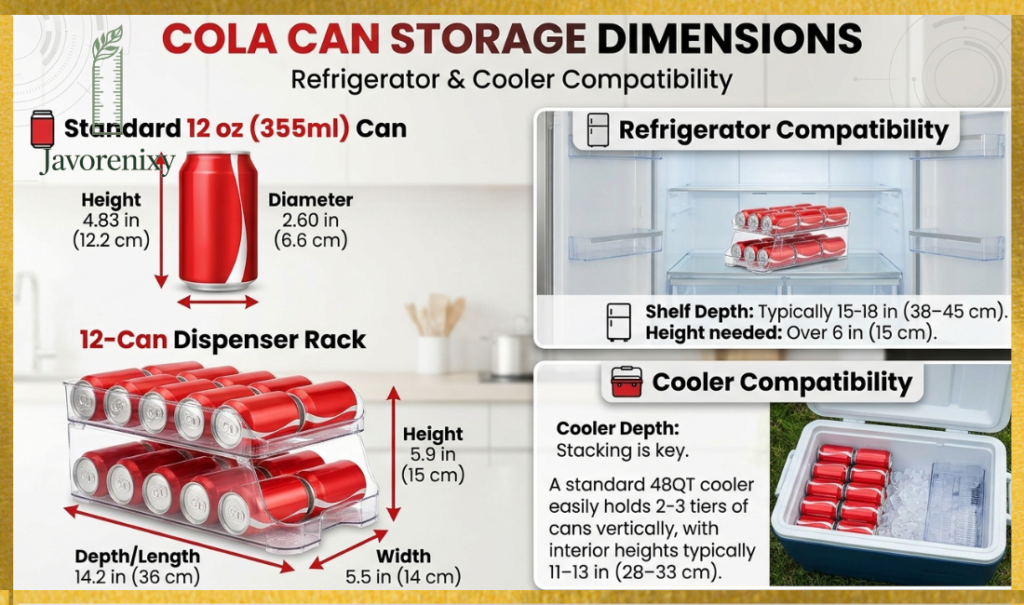
A regular Coke can is fairly easy to store because of its compact cylindrical design.
At approximately 4.83 inches tall and 2.60 inches wide, a standard 12-ounce can fits comfortably on many refrigerator shelves.
Still, shelf arrangements aren’t always identical.
Some refrigerators have adjustable shelves, while others include narrow door compartments designed for smaller containers.
Here are a few useful storage tips:
For refrigerators: Measure the available vertical clearance before placing a large quantity of cans on a shelf.
For coolers: Consider both the can diameter and height. A cooler may have enough space for standard cans but struggle with taller formats.
For vending machines: Can dimensions must match the machine’s dispensing mechanism and storage channels.
For six-pack carriers: The packaging is generally designed around specific can dimensions, so substituting a different format may affect the fit.
A little planning can save you from the classic problem of buying a whole carton only to discover that your refrigerator shelf isn’t tall enough.
Coke Can Circumference for Stickers, Labels, and Custom Wraps
If you’re designing a sticker, promotional label, or decorative wrap, circumference becomes particularly important.
For a standard 12-ounce Coke can, the approximate body circumference is 8.17 inches, or 20.75 centimeters.
This gives you a starting point for calculating the length of a rectangular label.
However, there is one important detail: the label’s printable area should be measured separately from the full can height.
The upper shoulder curves inward, while the bottom section has a shaped transition. A flat sticker may not sit correctly across these areas.
For a custom design:
- Measure the straight central body section.
- Measure the circumference at the intended label position.
- Allow a small overlap or gap depending on your design.
- Avoid placing important text near curved edges.
- Test the label on an actual can before printing a large batch.
If you’re making a Coke can printable label, don’t assume that every 12-ounce can has exactly the same usable label area.
A small measurement difference can make the finished design look uneven.
Coke Can vs Pepsi Can: Are Their Dimensions the Same?
Coca-Cola and Pepsi are two of the world’s best-known soft drink brands.
Their traditional American 12-ounce aluminum cans generally use similar overall dimensions.
Both are designed around a 355 ml serving, and their standard packaging is intended to work with familiar retail displays, beverage carriers, and storage systems.
However, similar capacity doesn’t automatically mean identical dimensions.
Minor differences may occur in:
- Can height.
- Body diameter.
- Lid design.
- Shoulder shape.
- Manufacturing specifications.
For most everyday purposes, the two cans are comparable in size.
If you’re creating a custom holder or precision packaging, measure the exact product rather than relying on brand names alone.
Coke Can vs Red Bull Can: Understanding the Slim Format
Red Bull is well known for its narrower 250 ml energy drink can.
Compared with a standard American Coke can, a 250 ml Red Bull can usually has a slimmer appearance and a taller shape relative to its capacity.
| Feature | Standard Coke | Red Bull standard format |
|---|---|---|
| Capacity | 355 ml | 250 ml |
| Approximate ounces | 12 oz | 8.45 oz |
| General profile | Standard cylinder | Slim cylinder |
| Main purpose | Soft drink packaging | Energy drink packaging |
The Red Bull container is a useful example of how beverage packaging can communicate product identity through shape alone.
A narrower container can feel quite different in the hand, even when both products belong to the same broad category of aluminum beverage cans.
Coke Can vs Monster Can: Standard and Tall Packaging
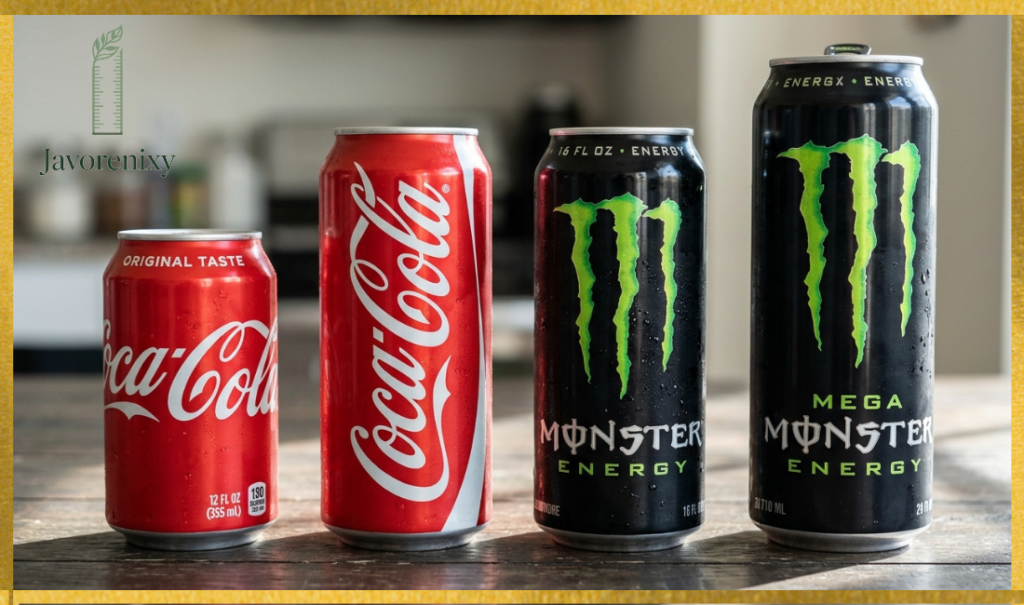
Monster Energy cans are often taller than traditional Coca-Cola cans.
A common Monster Energy format holds 16 fluid ounces, approximately 473 ml.
A standard American Coke can holds 12 fluid ounces, approximately 355 ml.
That means the Monster format contains about 33% more liquid.
The visual difference is also noticeable.
A Monster can generally has a taller body, while a traditional Coke can is shorter and more compact.
This comparison illustrates why beverage can dimensions comparison should always include capacity as well as physical measurements.
A larger volume doesn’t necessarily mean a proportionally larger height because manufacturers can adjust both the height and diameter.
How Are Coke Cans Manufactured?
The process behind a simple aluminum can is more fascinating than it first appears.
Although the exact production specifications vary, the general manufacturing process involves several stages.
Aluminum Sheet Preparation
Production begins with aluminum sheet material.
The metal is prepared and lubricated so that it can be shaped without excessive friction.
Drawing and Ironing
A circular piece of aluminum is formed into a shallow cup.
The cup is then stretched and ironed to create the tall, thin-walled can body.
This process helps produce a lightweight container with a consistent shape.
Trimming and Cleaning
The newly formed can may have an uneven upper edge.
Manufacturers trim it to the required height, then clean it to remove manufacturing residues.
Printing and Coating
The familiar Coca-Cola graphics are printed onto the exterior.
Protective coatings may also be applied to help maintain appearance and protect the aluminum surface.
Necking and Flanging
The upper portion is gradually narrowed, and the edge is prepared to receive the lid.
Lid Attachment
The beverage can is filled, and an aluminum end is attached using a double-seaming process.
This creates a secure closure that helps preserve carbonation and protect the contents.
Every stage requires carefully controlled manufacturing tolerances.
A tiny variation in the wrong place can affect how the can closes, holds pressure, or moves through automated packaging equipment.
Are All Coke Cans the Same Size?
No, and this is one of the biggest misconceptions about Coca-Cola packaging.
Different markets and retailers may offer different beverage capacities and physical formats.
For example:
- The United States commonly uses the 12 oz / 355 ml format.
- Several European markets commonly use 330 ml cans.
- Australia has a familiar 375 ml format.
- Some markets offer 250 ml slim cans.
- Mini cans are available in selected product ranges.
Even two cans with the same capacity may have different heights and diameters.
The reason is that packaging engineers can change the proportions to meet regional production requirements, retail preferences, and distribution needs.
So, when somebody asks, “How big is a Coke can?” the most useful response is to ask which format they mean.
Frequently Asked Questions About Coke Can Size
How tall is a standard 12 oz Coke can?
A standard American 12-ounce Coke can is approximately 4.83 inches tall, equivalent to 12.27 centimeters or 122.68 millimeters.
How wide is a Coke can?
The main body diameter of a traditional 12-ounce Coca-Cola can is approximately 2.60 inches, or 66.04 millimeters.
What is the circumference of a standard Coke can?
Its approximate body circumference is 8.17 inches, equivalent to 20.75 centimeters.
This is particularly useful when calculating sticker and wrap dimensions.
How many milliliters are in a regular Coke can?
A standard American Coke can contains approximately 355 ml.
However, other markets commonly sell 250 ml, 330 ml, and 375 ml formats.
What is the diameter of a Coke can lid?
The lid diameter is smaller than the main body diameter. A commonly referenced approximate figure is 2.13 inches, or 54.10 millimeters.
Actual end specifications can vary.
How much does an empty Coke can weigh?
A lightweight standard aluminum beverage can may weigh approximately 13–15 grams, depending on its construction.
Does a Coke can fit in a car cup holder?
Most standard 12-ounce cans fit many conventional car cup holders because their body diameter is around 2.60 inches.
However, the fit depends on the vehicle and holder design.
Is a 330 ml Coke can smaller than a 355 ml Coke can?
Yes, in terms of liquid capacity. A 330 ml can contains 25 ml less beverage than a 355 ml can.
Its physical dimensions may also differ.
What is a 202 end on a Coke can?
A 202 end is a common beverage-can lid specification. It refers to the end’s nominal diameter designation and is associated with modern beverage can closures.
Can I use the same label size for every Coke can?
Not necessarily. Different can formats have different circumferences and usable label heights.
Always measure the exact container before printing custom labels.
9 inches
9 inches is a measurement of length equal to 22.86 centimeters or 228.6 millimeters. It represents a distance slightly shorter than the length of a standard sheet of paper.
how big is 9 inches
9 inches is about the length of a large smartphone, a small ruler, or a medium-sized kitchen knife. It gives a clear idea of size when compared with everyday objects.
what is 9 inches
9 inches means a length measurement that equals 3/4 of a foot. It is commonly used to describe the size of objects, tools, and household items.
9inches
9inches refers to a measurement of nine inches in length. This size can be visualized through common items like a dinner plate’s diameter or a tablet’s shorter side.
9 inch objects
Many everyday items are around 9 inches long, including some smartphones, rulers, small books, and kitchen utensils. Comparing objects helps make this measurement easier to understand.
Practical Tips for Measuring a Coke Can at Home
You don’t need professional packaging equipment to measure an ordinary Coke can.
A ruler, measuring tape, and a little patience are usually enough.
Here’s a simple approach:
To measure height: Place the can upright on a flat surface and measure from the bottom to the top of the lid.
To measure diameter: Measure straight across the widest part of the can body, passing through its center.
To measure circumference: Wrap a flexible measuring tape around the main body without stretching it.
To measure the lid: Measure across the circular top, not the pull tab.
To measure capacity: Check the printed volume on the packaging rather than estimating it from physical dimensions.
For more accurate results, take each measurement twice.
If you’re using the dimensions for product packaging, manufacturing, or commercial label printing, consult the actual packaging specification sheet. General internet measurements are helpful for everyday comparisons, but they aren’t a substitute for manufacturer drawings.
Read this blog https://javorenixy.com/pokemon-card-dimensions-2/
Conclusion: Why Coke Can Size Is More Interesting Than It Looks
A Coca-Cola can might seem like one of the simplest objects in your refrigerator, but its design brings together practical measurements, clever engineering, material efficiency, and everyday convenience.
The standard American 12-ounce Coke can measures approximately 4.83 inches in height and 2.60 inches in body diameter. Its circumference is around 8.17 inches, and it holds approximately 355 ml of beverage.
But the world of Coca-Cola packaging extends well beyond that familiar format.
Mini cans provide smaller servings, 250 ml slim cans offer a narrower profile, European markets commonly use 330 ml formats, and Australian packaging includes the familiar 375 ml option.
Understanding these differences can help with everything from refrigerator organization and cup holder compatibility to custom label design and packaging projects.
The next time you open a Coke, take a second to appreciate that little aluminum cylinder. Its proportions aren’t random. Almost every curve, measurement, and manufacturing decision has a purpose.
And that’s what makes Coke Can Size such an unexpectedly interesting subject.
Whether you’re comparing beverage containers, creating a custom sticker, or simply satisfying your curiosity, knowing the measurements gives you a much clearer picture of the object you’ve probably held hundreds of times.
Have you ever compared Coca-Cola cans from different countries, or noticed how different mini and standard cans feel in your hand? Share your observations and favorite size comparisons in the comments!
