
There is something oddly satisfying about holding a trading card in your hands. It isn’t just paper, and it isn’t only artwork either. Somehow it feels like a tiny doorway into a memory.
Maybe you remember opening your very first booster pack, hoping for that shiny holographic pull, or maybe you’re just getting into collecting today.
Funny thing is, most people admire the artwork but rarely stop to think about the exact Pokemon Card Dimensions that make every card fit perfectly into sleeves, binders, grading cases, and millions of collections around the world. Thats kinda amazing when you think about it.
Whether you’re a collector, artist, seller, custom card designer, or simply curious about pokemon card dimensions, knowing the precise measurements matters far more than most people expect. A fraction of a millimeter can separate an Authentic Pokémon Card from a suspicious fake.
The right dimensions also ensure your cards slide smoothly into protectors without bending corners or damaging valuable collectibles.
In this guide, we’ll explore the complete Pokémon Card Measurements, compare them with everyday objects, explain different card types, discuss printing specifications, storage accessories, grading standards, and even digital canvas sizes for designers. By the end, you’ll probably never look at a Pokémon card quite the same way again.
| Measurement | Standard Size |
|---|---|
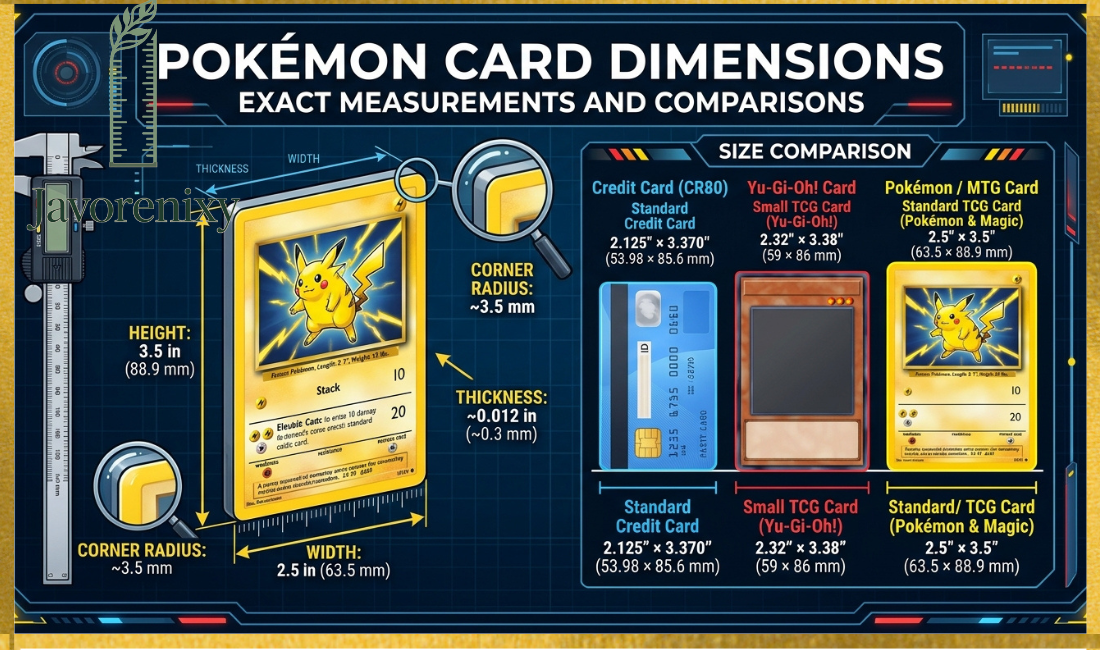
| Width | 2.5 in (63.5 mm / 6.35 cm) |
| Height | 3.5 in (88.9 mm / 8.89 cm) |
| Thickness | ~0.3 mm (0.012 in) |
| Corner Radius | ~3 mm (0.12 in) |
| Card Type | Standard trading card (Poker size) |
| Same Size As | Magic: The Gathering, standard playing cards |
Pokemon Card Dimensions Explained
The official Pokémon Trading Card Game (TCG) follows an industry-standard trading card format that has remained remarkably consistent for decades.
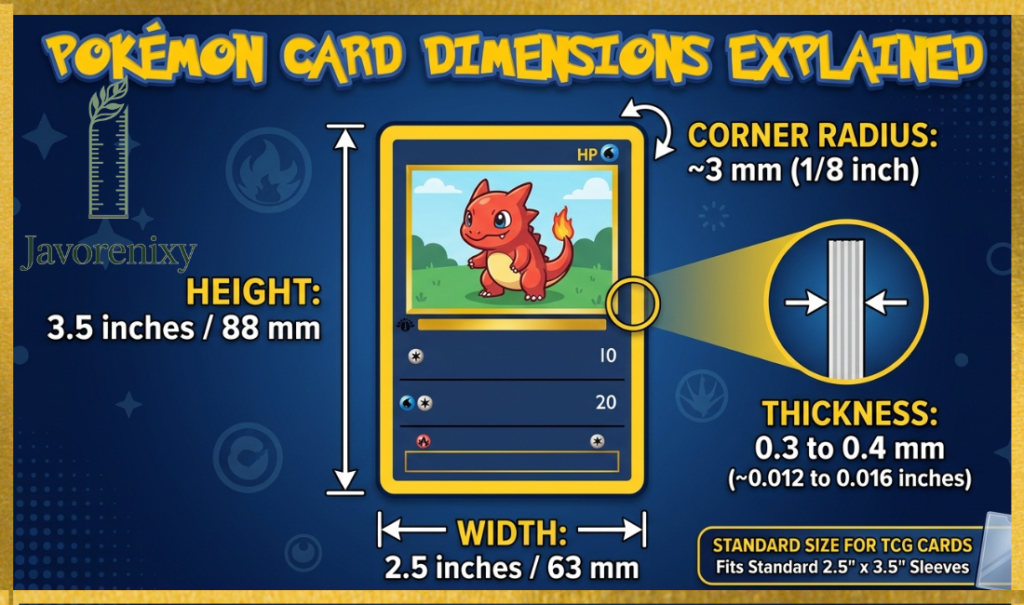
The official Standard Pokémon Card measures:
| Measurement | Size |
|---|---|
| Width | 2.5 inches |
| Height | 3.5 inches |
| Millimeters | 63.5 × 88.9 mm |
| Centimeters | 6.35 × 8.89 cm |
| Aspect Ratio | 5:7 |
| Corner Radius | 0.125 inch |
These measurements define the official Pokémon Card Size used worldwide for English-language releases and nearly every modern expansion. That consistency is what allows collectors to purchase sleeves, binders, and grading holders without worrying about compatibility.
Even though the measurements appear simple, manufacturing allows tiny variations called Manufacturing Tolerance, usually around ±0.2 mm tolerance or ±0.3 mm tolerance, depending on production facilities. Thats completely normal, by the way.
Pokemon Card Measurements: Every Detail Matters
When people ask about pokemon card measurements, they usually only think about width and height. But there are many physical characteristics that make an authentic card.
Important specifications include:
- Card Width: 63.5 mm
- Card Height: 88.9 mm
- Card Thickness: approximately 0.30–0.32 mm thickness
- Foil Card Thickness: approximately 0.35 mm foil thickness
- Card Weight: roughly 1.70–1.80 g weight
- Rounded Corner Radius
- Multi-layer Cardstock
- Internal Graphite Core layer
The internal Tri-layer cardstock construction gives official cards their familiar stiffness. Sandwiched between paper layers is the dark Graphite Core, which helps prevent transparency and improves durability.
Collectors often use a digital caliper and a precision scale when examining expensive cards because these measurements can reveal inconsistencies.
Pokemon Card Dimensions Compared With Everyday Objects
Numbers don’t always paint the clearest picture. Comparing cards to familiar items makes the size much easier to imagine.
Pokémon Card vs Credit Card
A credit card is shorter but noticeably wider.
- Pokémon card: 63.5 × 88.9 mm
- Credit card: 85.6 × 53.98 mm
A Pokémon card looks taller and slimmer.
Pokémon Card vs Playing Card
Standard poker playing cards are almost identical.
Both share nearly identical Trading Card Dimensions, which is why many card accessories fit both.
Pokémon Card vs Dollar Bill
A U.S. dollar bill is much wider and shorter.
The card covers only a portion of the bill, making the currency seem surprisingly oversized.
Pokémon Card vs Smartphone
Even compact smartphones are significantly larger.
Lay a card on your phone and you’ll notice it covers only part of the display, which kinda surprises people the first time.
Pokémon Card vs Baseball Card
Baseball cards generally use the same standard dimensions, making collector supplies interchangeable.
Pokémon Card vs Magic: The Gathering Cards
Magic: The Gathering cards share nearly identical sizing, allowing common storage products to work across games.
Pokémon Card vs Yu-Gi-Oh Cards
Yu-Gi-Oh card size differs noticeably.
Yu-Gi-Oh cards are slightly smaller, meaning Pokémon sleeves won’t fit them snugly.
Pokemon Card Size in Inches, Millimeters, and Centimeters
Different regions use different units, so here’s a quick reference.
| Unit | Official Size |
|---|---|
| Inches | 2.5 × 3.5 inches |
| Millimeters | 63.5 × 88.9 mm |
| Centimeters | 6.35 × 8.89 cm |
Knowing pokemon card dimensions in inches, pokemon card dimensions in mm, and pokemon card dimensions in cm is especially useful when ordering custom printing or designing digital artwork.
Pokemon Card Dimensions for Digital Design
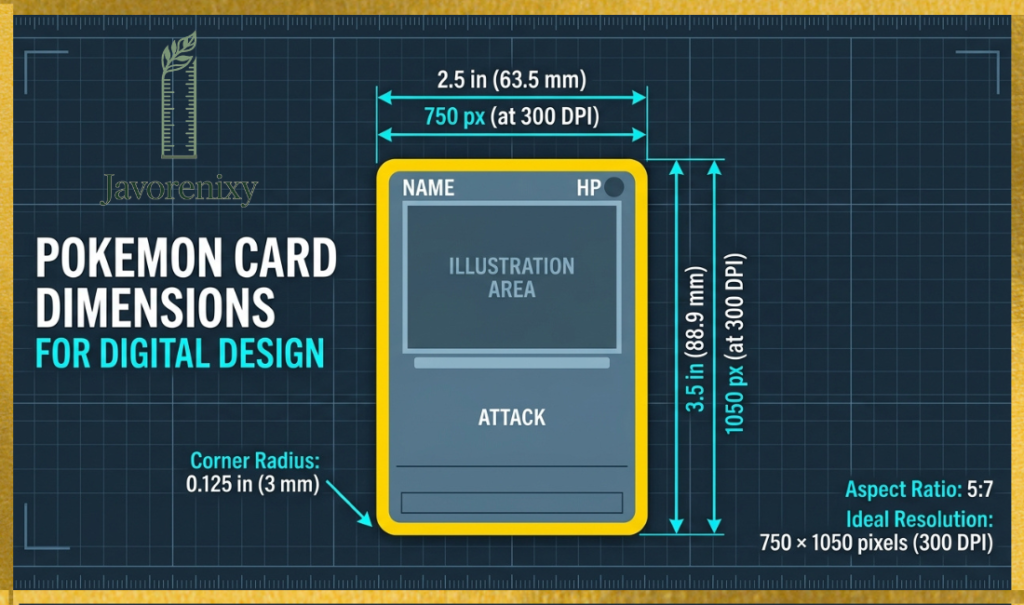
Artists creating custom cards often need exact digital specifications.
Common Canvas Size options include:
| Resolution | Recommended Use |
|---|---|
| 180 × 252 pixels | Thumbnail previews |
| 375 × 525 pixels | Web graphics |
| 750 × 1050 pixels | Basic digital artwork |
| 825 × 1125 pixels (with bleed) | Professional printing |
| 1500 × 2100 pixels | High-resolution projects |
Most designers work at 300 DPI, although premium printing often uses 600 DPI for sharper results.
When creating artwork, always include:
- Print Bleed
- Safe Zone
- Proper Pixel Dimensions
- Correct Digital Resolution
Ignoring these settings can cause borders to shift after trimming, which nobody wants after spending hours on artwork.
Printing Specifications for Custom Pokemon Cards
Whether making fan art or prototypes, understanding pokemon card print size prevents disappointing results.
Professional printers typically recommend:
- 300 DPI
- 600 DPI for premium detail
- Proper RGB color profile during design
- CMYK printing before production
- Correct Print Bleed
- Safe margins
Keeping artwork inside the Safe Zone prevents important text or illustrations from being accidentally trimmed.
Card Thickness and Materials
Official Pokémon cards are more sophisticated than ordinary paper.
Their layered construction includes premium Cardstock, specialized coatings, and an internal Graphite Core.
Different versions may vary slightly:
- Standard cards
- Holographic Card
- Foil Card
- Full-Art Card
Although foil versions measure approximately 0.35 mm foil thickness, the difference is subtle enough that sleeves still fit normally.
Jumbo Pokémon Card Dimensions
Not every Pokémon card follows the standard format.
Oversized promotional cards have become collector favorites.
Common examples include:
- Jumbo Pokémon Card
- Box Topper Card
- CoroCoro XXL Card
- Topps Mega Chrome
Each has unique sizing depending on release year and promotion.
Because these cards vary greatly, standard sleeves and binders rarely fit them correctly.
Japanese Pokémon Cards vs International Pokémon Cards
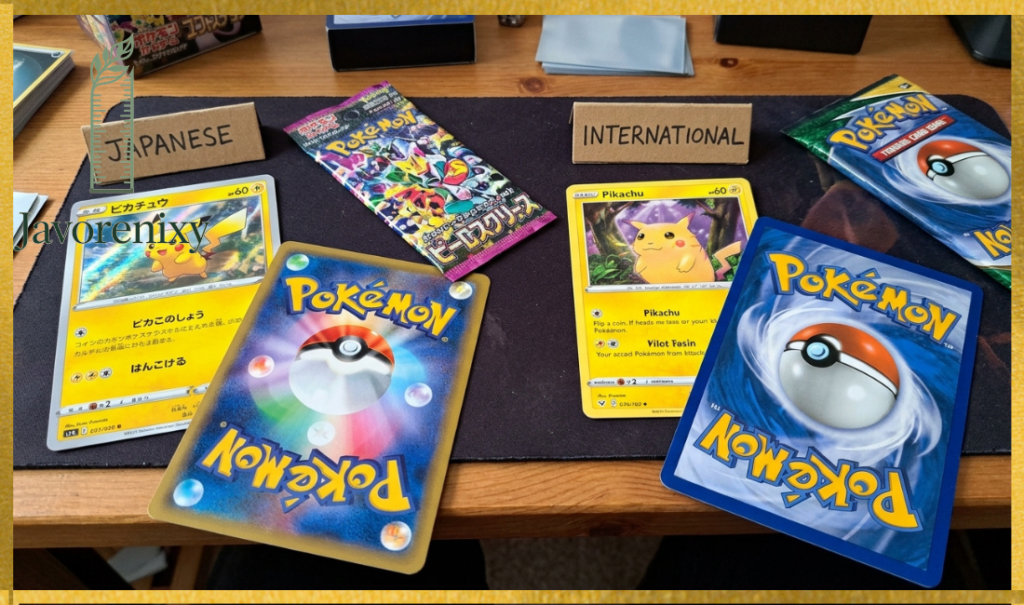
Many collectors wonder whether Japanese Pokémon Cards differ in size.
Fortunately, both International Pokémon Cards and Japanese releases generally share the same physical dimensions.
The main differences involve:
- Print quality
- Card finish
- Text language
- Release schedule
- Packaging
That’s why accessories usually work equally well for both versions.
Pokemon Card Sleeve Size Guide
Protecting cards is essential for long-term preservation.
Recommended accessories include:
| Accessory | Size |
|---|---|
| Perfect Fit Sleeves | 64 × 89 mm |
| Standard Outer Sleeves | 66 × 91 mm |
| Japanese sleeves | 62 × 89 mm |
Many collectors prefer double sleeving, placing the card inside a perfect-fit sleeve before inserting it into an outer sleeve.
This creates extra protection against moisture, dust, fingerprints, and accidental spills.
Best Toploaders and Binder Pockets
Rigid protection is ideal for valuable collectibles.
Most collectors recommend:
- 35 PT Toploader
- 55 PT Toploader
- Premium Binder Pockets
- Acid-free card protector
- Archival trading card sleeves
Using proper archival storage dramatically reduces long-term wear. Cards kept loose inside drawers often develop whitening along the edges, and thats honestly painful for collectors.
Authentic Pokémon Card vs Fake Pokémon Card
One of the biggest reasons collectors research pokemon card dimensions is counterfeit detection.
Fake cards often show subtle differences including:
- Incorrect width
- Wrong thickness
- Low-quality Cardstock
- Missing Graphite Core
- Poor corner cuts
- Incorrect weight
- Weak colors
- Blurry printing
When performing Card Authentication, experienced collectors check dimensions using calipers before examining artwork.
Another popular method is the light test, although it should never be the only authentication method.
Pokemon Card Grading Standards
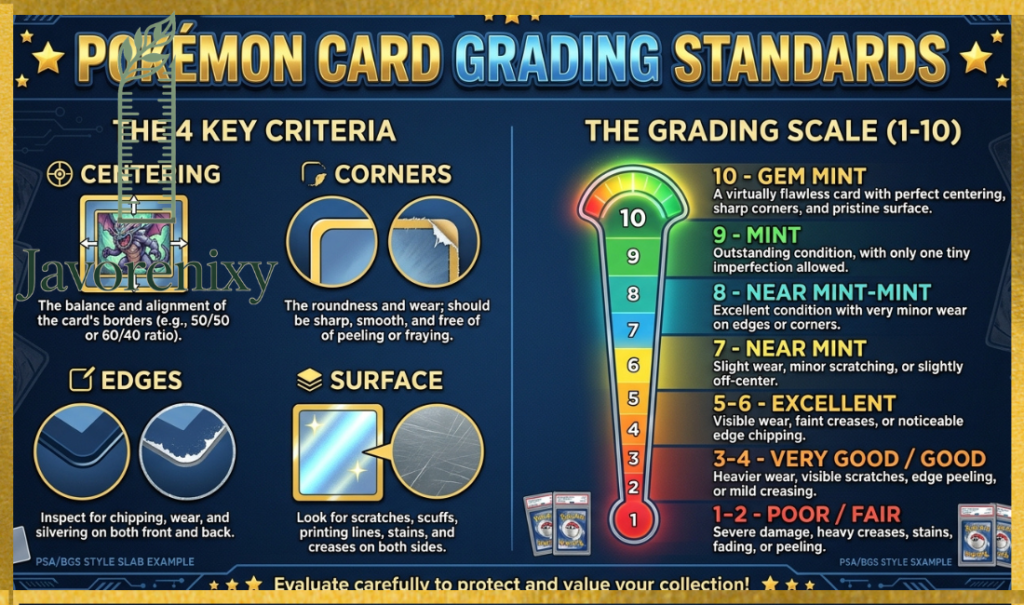
Professional grading companies inspect cards with incredible precision.
Popular services include:
- PSA Grading
- BGS Grading
During grading, experts evaluate:
- Centering analysis
- Surface quality
- Edge condition
- Corner quality
- Dimensions
- Authenticity
A card measuring outside acceptable Manufacturing Tolerance could raise questions during authentication.
Pokemon Card Dimensions for Artists
Custom creators using Photoshop or Procreate Canvas should carefully prepare artwork before printing.
Helpful checklist:
- Correct Canvas Size
- Accurate Aspect Ratio
- Proper Digital Resolution
- Print Bleed
- Safe margins
- High-quality artwork
- Export at 300 DPI or 600 DPI
Using templates built specifically for pokemon card procreate template projects saves considerable editing time.
Why Exact Measurements Matter
Tiny measurements influence nearly every aspect of collecting.
Correct sizing ensures:
- Sleeves fit properly.
- Binder pages remain secure.
- Grading holders close correctly.
- Printed proxies align perfectly.
- Custom artwork trims accurately.
- Authentic cards pass inspection.
It sounds dramatic, maybe just a lil bit, but fractions of a millimeter genuinely matter in the trading card hobby.
Common Questions About Pokemon Card Dimensions
How big is a Pokémon card?
The official size is 2.5 × 3.5 inches or 63.5 × 88.9 mm.
Are all Pokémon cards the same size?
Almost all standard releases use identical measurements, although promotional oversized cards differ.
What sleeve fits Pokémon cards?
Most collectors choose 64 × 89 mm Perfect Fit Sleeves with 66 × 91 mm Standard Outer Sleeves.
Are fake Pokémon cards a different size?
Many counterfeit cards deviate slightly in width, thickness, or weight, making measurements useful during pokemon card authentication.
Can I print my own Pokémon cards?
Yes, for personal projects and custom artwork, provided you use proper Printing Resolution, Print Bleed, and respect intellectual property rights.
Frequently Asked Question
pokemon card dimensions
The standard pokemon card dimensions are 2.5 × 3.5 inches (63.5 × 88.9 mm). This official size is used for most Pokémon Trading Card Game (TCG) cards worldwide.
dimensions of pokemon card
The dimensions of pokemon card are 2.5 inches wide by 3.5 inches tall, or 63.5 × 88.9 mm. These measurements allow cards to fit standard sleeves, binders, and toploaders.
what are the dimensions of a pokemon card
The dimensions of a pokemon card are 2.5 × 3.5 inches (6.35 × 8.89 cm or 63.5 × 88.9 mm). Minor manufacturing tolerances are normal, but official cards follow this standard size.
how big are pokemon cards
Pokemon cards are 2.5 inches wide and 3.5 inches tall, making them similar in size to standard trading cards. This consistent size helps with storage, grading, and protection.
how big is a pokemon card
A pokemon card is 2.5 × 3.5 inches (63.5 × 88.9 mm). It is slightly taller and narrower than a credit card, making it the standard size for Pokémon TCG collections.
Final Thoughts
Learning the exact Pokemon Card Dimensions is about much more than memorizing numbers. Every measurement tells part of the story behind one of the world’s most beloved collectibles.
From the official 2.5 × 3.5 inches size to the carefully engineered Graphite Core, premium Cardstock, accurate Aspect Ratio, and professional Printing Resolution, each detail exists for a reason.
Whether you’re organizing binders, purchasing Toploaders, designing a custom Procreate Canvas, comparing pokemon card dimensions in pixels, checking pokemon card sleeve size, or trying to identify an Authentic Pokémon Card, understanding these specifications helps you make smarter decisions and better protect your collection.
The next time you hold a Pokémon card, pause for a second. It may look like a tiny rectangle, but inside those carefully measured Trading Card Dimensions lives decades of design, engineering, collecting culture, and countless childhood memories. Thats a pretty neat thing to remember.
